A Room That Keeps Its Own Secrets
Learn how a fictional room reveals history and tension through objects, physical traces, and omissions, so readers can infer the past without halting the scene.
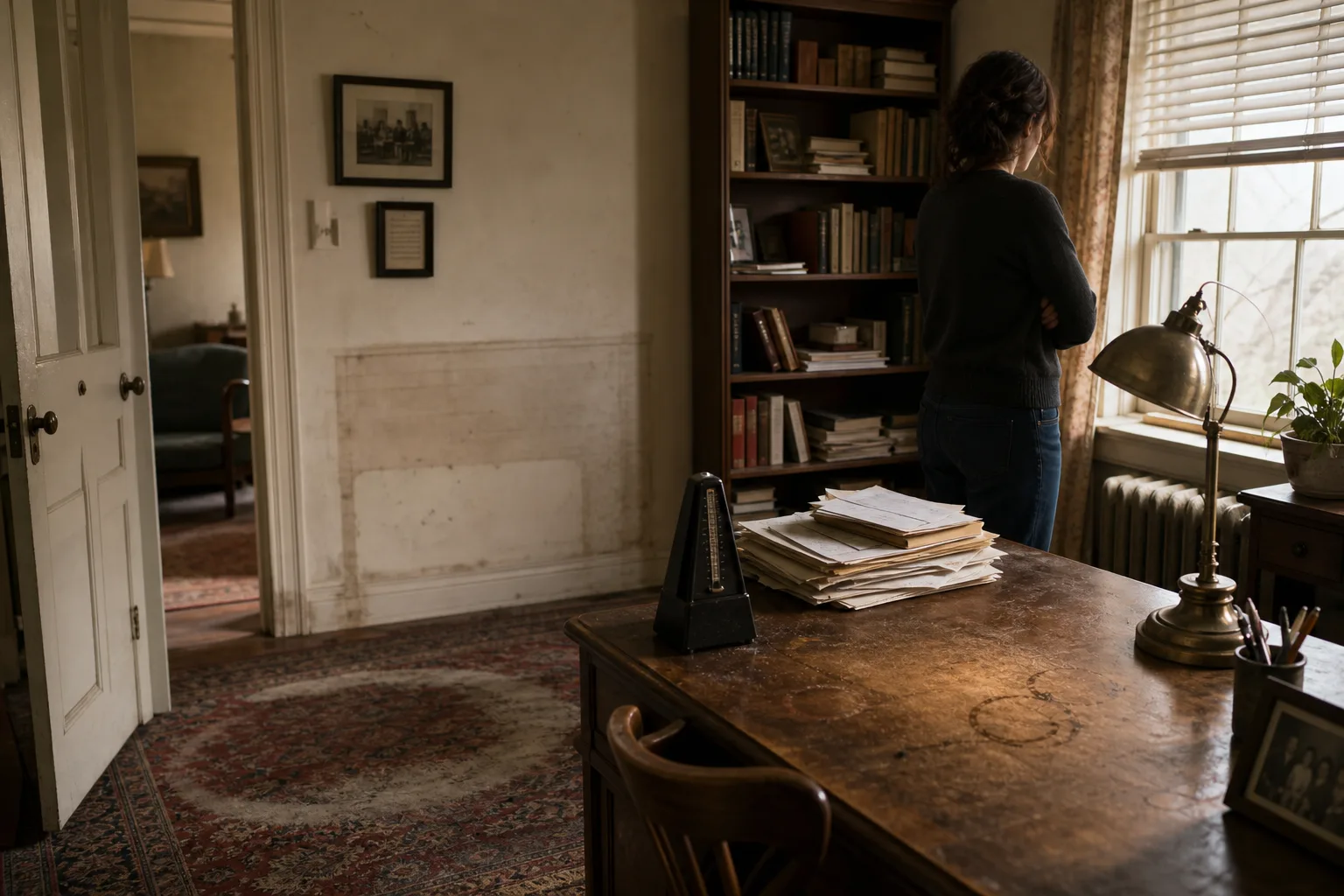
A fictional room can reveal history and tension before anyone explains what happened there. A ring-shaped stain on a desk, a chair turned toward the wall, or a clean rectangle among dusty shelves gives readers something specific to notice and interpret. The challenge is choosing details that feel like evidence rather than decoration.
When a room feels generic or overstuffed, revise its details in order: identify the scene’s pressure, choose a trace connected to the room’s past, tie that trace to the character’s present attention, and remove anything that explains too much. The setting can suggest a history without turning into a puzzle box.
Give an interchangeable room a specific past
If a bedroom, office, or kitchen could be swapped for another without changing the scene, its details may be doing little beyond naming the furniture. A bed, desk, window, and lamp establish the room, but not what makes this particular one matter.
Decide what the room was used for before adding more objects. Perhaps it was a sewing room before it became a nursery, or an office where the occupant still angles the blinds away from a neighbor’s house. You do not need to explain that history directly; you need to know enough to choose the traces it might leave.
Use this short check to connect a room’s past to its current scene:
- Check whether the room has a former use; if it does, choose one visible trace, and if it does not, give it a past tied to a character or event.
- Check for a detail that marks the room’s current use; if one is present, set it against the older trace, and if none is present, add one object or action that shows how the space is used now.
- Check whether the contrast suggests a change; if readers can infer one, leave the explanation out, and if they cannot, make one trace more specific rather than adding a history paragraph.
- Check whether the scene depends on the room’s layout; if a door, window, or object affects movement, clarify its position, and if not, skip a floor-plan description.
Say you are writing a scene in a former music teacher’s parlor, now occupied by her adult son. The piano is gone, but the carpet remains compressed where its legs stood; beneath a pile of tax forms sits an unused metronome. The old purpose and the present one press against each other without requiring a paragraph of biography.
It is not worth the effort to invent a complete floor plan before you know what the scene needs. A few spatial facts that affect movement, attention, or memory are more useful than a private architect’s dossier.
Choose objects that point to a particular history
A room full of interesting things can still feel empty if none connects to a specific past. A cracked mug, a stack of books, and a faded rug become evocative when their condition or placement gives readers something to infer.
Ask what each object can quietly suggest: who handled it, what it was used for, or why it remains. Height marks on a doorframe can suggest years of visits or growth. A second toothbrush in a guest bathroom may imply an arrangement that has ended, though the current owner has not cleared it away.
When an object feels arbitrary, connect it to the scene. The viewpoint character might recognize it, avoid touching it, or notice that someone moved it. That response lets the detail carry meaning without making the narrator announce a single interpretation.
Imagine a daughter entering her late father’s workshop. A jar of screws is arranged by size, but one wrench lies in the middle of the workbench. She remembers that he insisted every tool return to its place; her hand hovering over the wrench can suggest both the habit and the interruption without spelling out what the object means.
Resist assigning every object a symbolic job. If the curtains mean grief, the clock means guilt, the vase means betrayal, and the carpet means childhood, the room can look arranged for a literature class. Let ordinary things remain ordinary around the details that matter.
Use physical traces instead of history lectures
Writers sometimes explain a room’s history because they worry readers will miss it. The result can be a character mentally reciting facts they already know: the chair belonged to an aunt, the wallpaper went up after a divorce, and nobody has opened the cupboard since the move.
Replace some explanation with physical traces. A wallpaper pattern visible beneath a lifted corner, a polished patch on a banister, or a cupboard door swollen shut can hint at use, neglect, or concealment. The trace should make sense for the room and connect to what the scene is doing now.
Use these checks to decide which trace belongs:
- Check where hands, shoes, sunlight, or furniture have repeatedly touched the room; if that contact supports the scene, show its mark, and if not, leave the surface undescribed.
- Check whether something has been removed; if an outline or mark remains and matters to the character, include it, and if the absence has no bearing on the scene, omit it.
- Check for a repair; if its careful or hurried condition suggests something relevant, keep it, and if it adds no useful implication, remove it.
- Check whether an untouched corner or surface draws the character’s attention; if there is a reason for the avoidance, use it, and if not, let it remain part of the background.
A trace can change how a character reads the room without settling its meaning. A newly painted patch might suggest repair to one person and concealment to another. Keep that uncertainty if it adds pressure; not every mark needs a confirmed explanation.
Make omissions noticeable without making them vague
An absence becomes meaningful when readers have a reason to notice it. An empty wall is not automatically suspicious, but an empty wall where the viewpoint character expects a portrait can prompt a question. An omission needs a visible expectation, not just missing information.
Establish what should be there through memory, a familiar arrangement, or another object’s position. Then let the absence register briefly: a nail remains above the mantel, but the photograph is gone; a shelf is dusty except for a clean oval where a bowl once sat. Such details imply removal while leaving open who did it and why.
Avoid listing everything missing. If the prose mentions the absent rug, telephone, mirror, second cup, and any sign of children, readers have too many threads to follow. Choose the absence that presses on the scene’s central unease and let the rest of the room go unremarked.
Match the omission to what the viewpoint character would notice. Someone who knows the room well might spot a missing book at once; a visitor might register only the pale patch left on the shelf. The detail should fit what this person can reasonably see and care about in that moment.
Let details support competing explanations
A room can feel tense when its details support more than one explanation. A locked cabinet might protect private letters, preserve fragile keepsakes, or keep a toddler away from cleaning supplies. If the story confirms one answer too quickly, the detail stops creating pressure.
Build ambiguity from concrete facts rather than fog. Perhaps the cabinet has a fresh scratch beside the lock, the key is missing from its usual hook, and the viewpoint character knows someone entered the house. Readers can form possibilities from those facts instead of guessing at random.
Set one detail against another. A room may be carefully dusted while its window latch is neglected; a desk may be cleared while its wastebasket overflows with shredded paper. The contrast invites readers to wonder what matters to the person who maintains the space.
Keep the possible explanations connected. If every object points toward a different secret, the room feels like a collection of clues with no shared source. Choose a central pressure—someone left, someone is hiding something, or the room is being prepared for a return—and let the details approach it from different angles.
Give the viewpoint character a reason to notice
Setting details can feel pasted into a scene when the viewpoint character has no reason to attend to them. Someone hurrying to hide a letter may not pause to admire the floorboards; they might notice that the boards creak by the door because that could alert someone nearby.
Connect observation to a present need: searching, avoiding, remembering, waiting, or trying to appear calm. The same room changes according to who enters it. A former tenant may notice a repaired hole in the wall; a stranger may notice only the smell of damp plaster.
Ask what the character needs from the room right now. They may need privacy, a place to hide, proof that someone has been there, or an excuse to stay. Details that help or frustrate that need will feel selected rather than pasted in.
Let attention shift as the scene shifts. A character might scan shelves for a missing ledger, then fix on a thin curtain after hearing footsteps outside. That change keeps the room active without making it take over the scene.
Revise room details in a deliberate order
When a setting feels flat, confusing, or overloaded, revise from purpose to language rather than polishing every sentence at once. Check each point below and choose the action that fits what you observe.
- Name the scene’s pressure. Check whether the moment has a clear stake, such as finding or hiding something; if it does, keep that pressure in view, and if not, clarify what the character is trying to do.
- Choose the room’s relevant past. Check whether a former use, recent change, or personal history could leave a visible trace; if one can, select it, and if none serves the scene, do not invent extra backstory.
- Select the details. Check whether an object, physical mark, or absence supports the pressure; if it does, keep it and give the character a reason to notice, and if it does not, cut it.
- Attach details to attention or action. Check whether the character touches, avoids, recognizes, misreads, or searches around a detail; if so, use that action, and if not, connect the detail to a present need or remove it.
- Check the reader’s footing. Check whether the door, window, or important object needs a spatial cue; if the layout affects action, clarify its position, and if not, leave out extra directions.
- Remove duplicate signals. Check whether several details all suggest neglect or secrecy; if they do, keep the strongest and let the others serve different purposes or go.
- Delay explanation. Check what the character knows at this point; if a fact is necessary to follow the action, state it, and if the meaning can remain uncertain, let the reader infer it.
Imagine you are revising a scene in which Mara enters her brother’s unused study to retrieve a ledger before he returns. First, you note the scene’s pressure: she needs the ledger without drawing attention. Next, you decide the room was recently used as a packing space, so you keep a strip of tape on the desk and remove unrelated details about its earlier decor. Then you place the desk between Mara and the doorway, give her a reason to notice the chair’s fresh scrape across the floor, and cut a second mark that also suggests movement. The result is a clear route to the ledger and one unresolved sign that someone moved the chair; you preserve that uncertainty instead of explaining who did it.
What questions help a room’s secrets feel earned?
How many meaningful objects should a room contain?
Use only as many as readers can notice and connect to the scene. One vivid object with a clear relationship to the character often carries more weight than a long inventory.
Should the narrator explain what an object means?
Explain a fact when readers need it to follow the action, but leave emotional interpretation open when uncertainty helps the scene. A character can recognize a familiar object without settling what its presence means.
How can a room feel mysterious without becoming confusing?
Make the physical facts clear and the explanation uncertain. Readers should understand what is missing, damaged, moved, or locked even if they do not yet know why.
What should happen if a room detail never pays off?
Check whether it still deepens character, mood, or spatial clarity. If it does none of those things, remove it; if it raises a question the story intends to leave open, make that question feel deliberate rather than forgotten.
Keep the room suggestive, not overcrowded
A room that keeps its own secrets does not need to hide a dramatic revelation. Its history can live in the way a chair faces an unused fireplace, in the clean space left by a removed picture, or in the one object someone has carefully put back.
When revising, ask whether the fictional room reveals history and tension through what a character notices, touches, or cannot find. If it does, the setting gives readers evidence, room to interpret it, and a reason to keep looking. Keep that search focused: the strongest detail is often the one that makes the next action feel newly charged.
Another story nearby

The Character Who Wants Two Opposite Things
Use a character-with-opposing-desires prompt to build a concrete choice, reveal what matters to your protagonist, and…
What Changes When the Plan Fails?
A failed plan in a story should create a fresh choice, not just a delay. See…